Learning from Kitsch Land
A reflection on the lessons, perspective, and enduring influence of Kitsch Land
DESIGN / ESSAY · REVISED 2026
Learning from Kitsch Land
What can “bad taste” teach design? More than modernism wanted to admit—and perhaps more than our image-saturated present is willing to remember.
By Luigi Seta, Architect · Originally published in Imago, 1999 · Revised and expanded, 2026
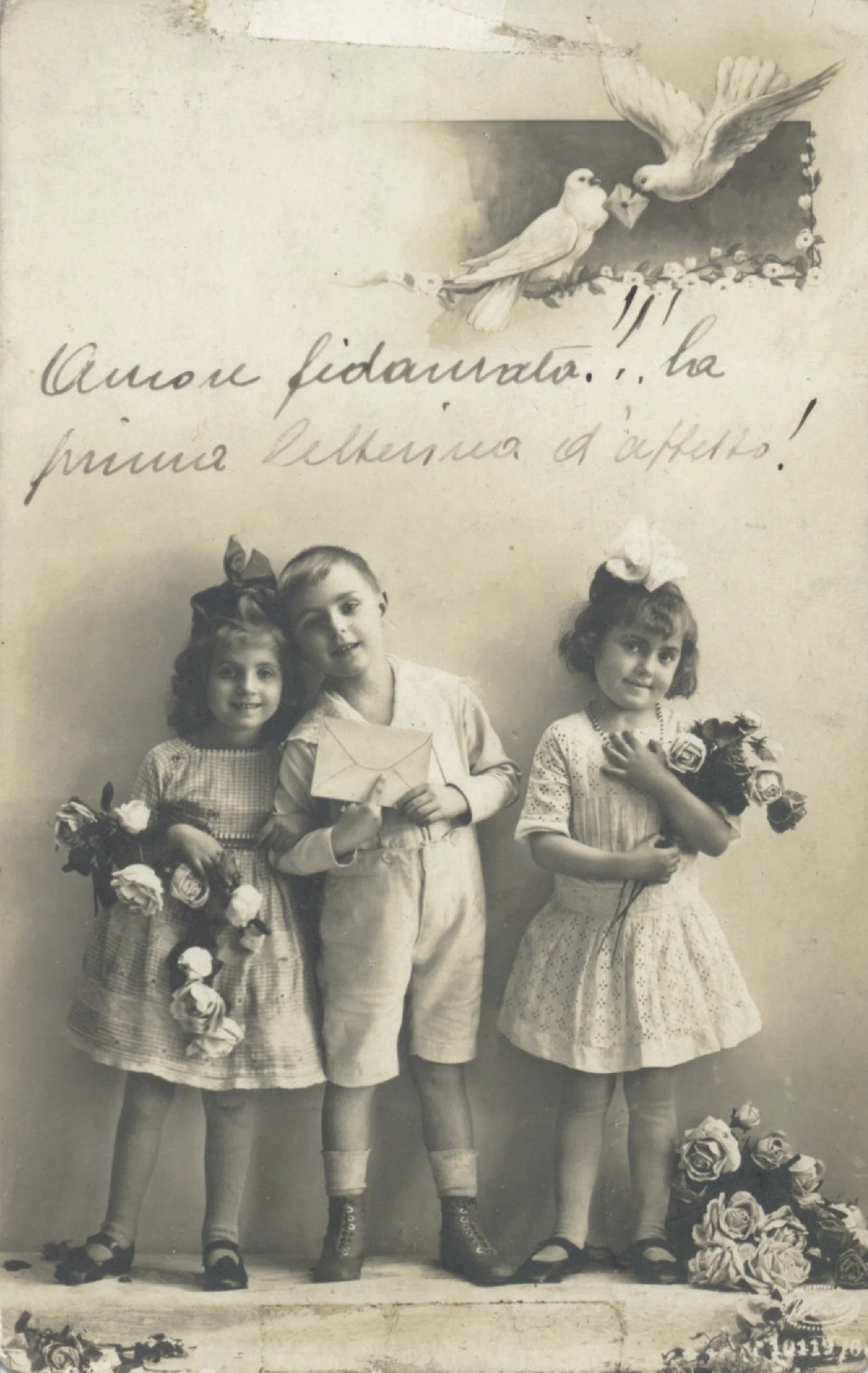
Amore. Vintage postcard from the author’s collection; scanned from the original print.
I still remember being a young and rather romantic architecture student when I first encountered Learning from Las Vegas, the provocative book by Robert Venturi, Denise Scott Brown, and Steven Izenour. I felt a mixture of surprise and aversion. How could the architecture of the “ugly and ordinary” deserve such serious attention? What would become of us designers in our spirited crusade for the dictatorship of good taste?
Were we expected to join Bad Taste Unlimited, Inc.? What, exactly, could kitsch teach us?
THE EMBARRASSMENT OF PLEASURE
Kitsch remains a troublesome word because it refuses to stay in one category. We use it to describe objects, images, interiors, gestures, even emotions. We call something kitsch when it appears too sentimental, too decorative, too obvious, too sweet, too theatrical—or simply too eager to please.
But I have never been convinced that kitsch is simply the opposite of art or good design. Kitsch is not merely pretense, because all art contains some form of artifice. Something else is happening: kitsch asks for our complicity. It invites us to enjoy what we have been taught we should reject.
That invitation is its subversive side.
In kitsch, the maker may pretend, the object may pretend, and we may knowingly pretend along with them. The exchange can be sentimental, ironic, affectionate, vulgar, theatrical—or all of those at once. Its value lies less in the isolated object than in the relationship it proposes.
There are no inherently kitsch objects. Kitsch is a relationship—an offered affair.
MODERNISM AND THE DISCIPLINE OF RESTRAINT
The stereotypical image of modern design is chaste, rational, and unadorned. That stereotype is not entirely fair to modernism, which was far more diverse than its later caricature, but the twentieth century undeniably inherited a powerful suspicion of ornament. Adolf Loos made that suspicion polemical in Ornament and Crime; Louis Sullivan’s earlier maxim that form follows function was later turned into something close to a moral commandment.
For decades, furniture and architecture were asked to justify themselves through function, economy, structure, and material honesty. Decoration often entered the room apologetically, if it entered at all.
Kitsch did not apologize.
A SOFA THAT SMILES BACK
The 1956 Marshmallow Sofa is a useful case. My original 1999 text followed the common attribution to George Nelson. The history is more interesting. The design emerged inside Nelson’s office and was developed by Irving Harper with Nelson after an inventor presented a supposedly inexpensive circular cushion. The cushion technology failed; the image did not. Eighteen upholstered discs, apparently floating on a steel frame, became one of the most memorable pieces of postwar American furniture.
Calling it “Pop Art furniture” is too simple. Pop Art was only then emerging, first in Britain and soon in the United States. Better to say that the Marshmallow Sofa anticipated Pop’s appetite for repetition, bright color, commercial imagery, humor, and the transformation of the ordinary into something slightly fantastic.
Herman Miller’s 1956 catalog famously reassured buyers that, despite its astonishing appearance, the sofa was comfortable. That sentence is almost more revealing than the object. Even a company at the center of American modern design felt compelled to justify pleasure with utility.
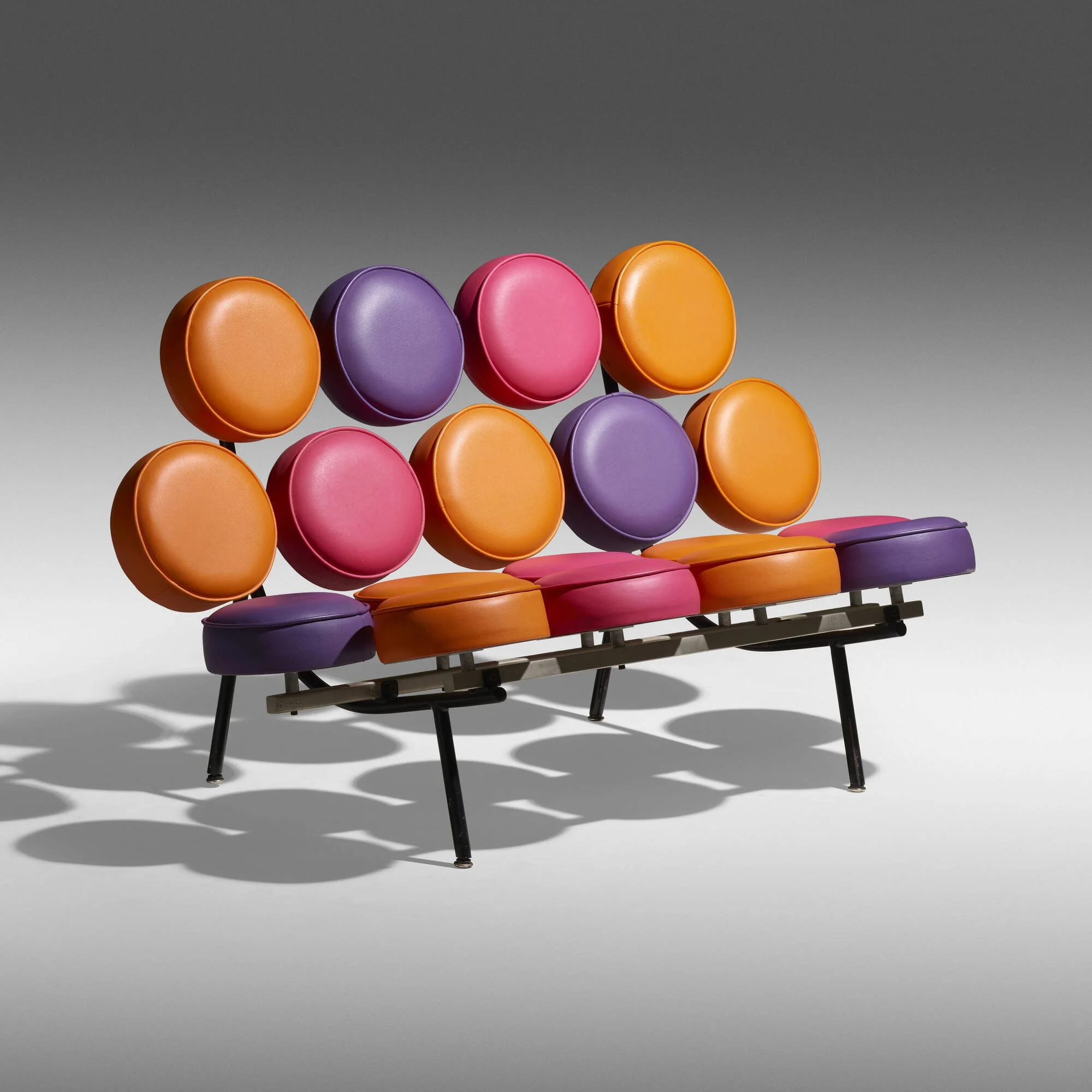
The modular discs make the sofa simultaneously rational and exuberant: industrial wearing party clothes.
POSTMODERNISM DISCOVERS THE FORBIDDEN DRAWER
By the 1970s and 1980s, the cultural climate had changed. Pluralism, historical quotation, irony, and ornament moved from the margins into architectural and design discourse. The point was not simply to decorate modernism but to challenge the assumption that one visual language could claim moral superiority over all others.
The Queen Anne Side Chair from the Venturi Collection for Knoll is an almost perfect demonstration. An eighteenth-century silhouette is flattened into industrially produced bent plywood. Its “Grandmother” surface pattern borrows the sweetness of a mass-produced floral tablecloth and overlays it with graphic marks associated with high-art quotation. Domestic nostalgia, historical furniture, industrial manufacture, and avant-garde culture occupy the same chair without asking permission from one another.
That collision is not an accident to be resolved. It is the design.
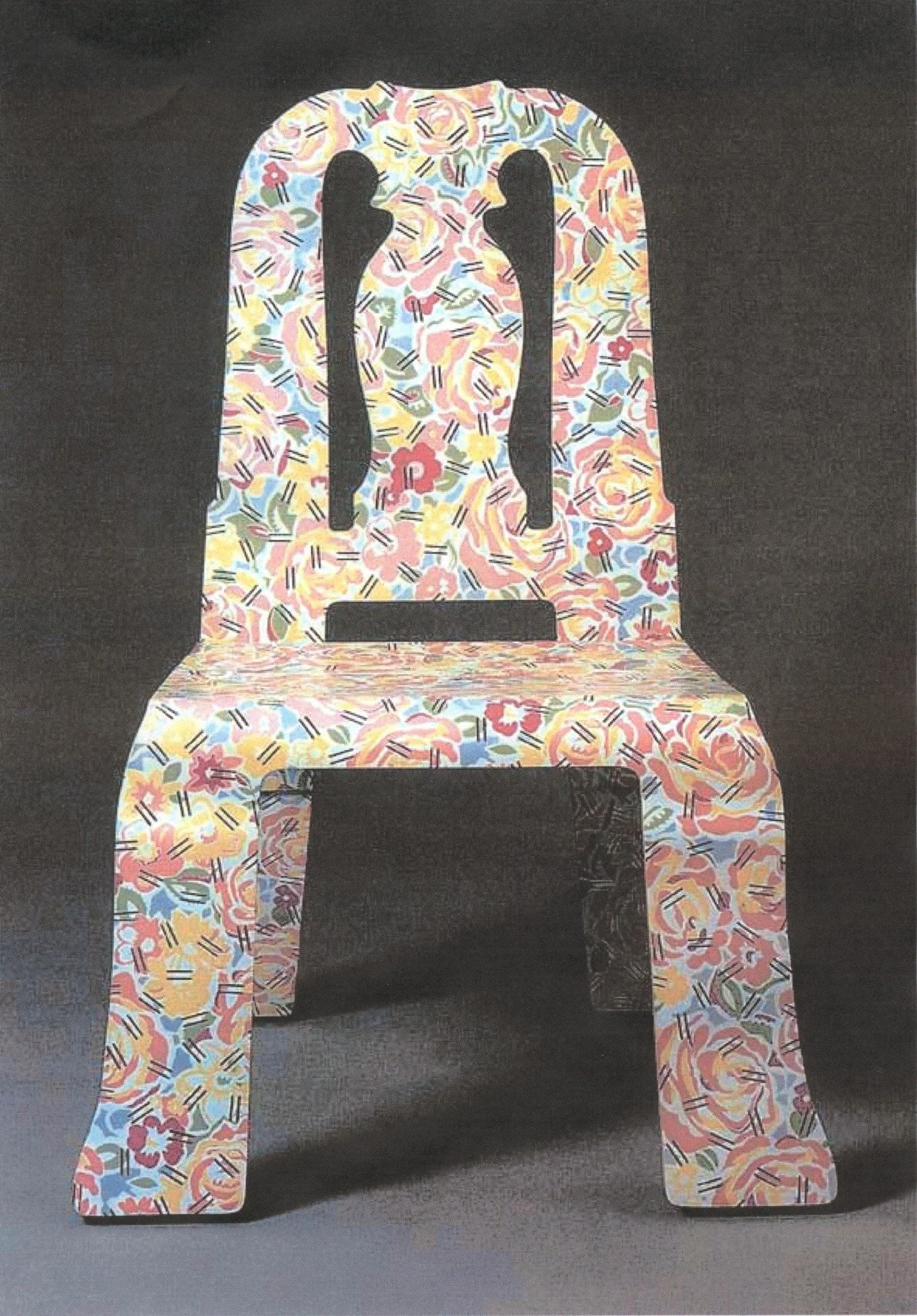
Queen Anne Side Chair: historical silhouette, industrial plywood, sentimental floral pattern, and deliberate contradiction.
KITSCH AFTER IRONY
When I wrote this essay in 1999, kitsch still seemed to need a defense. Today the problem is different. The old frontier between high and low culture has become porous to the point of near disappearance. Museums sell toys. Luxury brands borrow from street graphics. Minimalism and maximalism circulate as equally marketable identities. An image can move from vulgar to fashionable and back again before the paint is dry.
And now generative tools can reproduce almost any visual style instantly: baroque excess, Scandinavian restraint, Memphis exuberance, mid-century optimism, historical pastiche. Style itself is becoming cheap. Judgment is not.
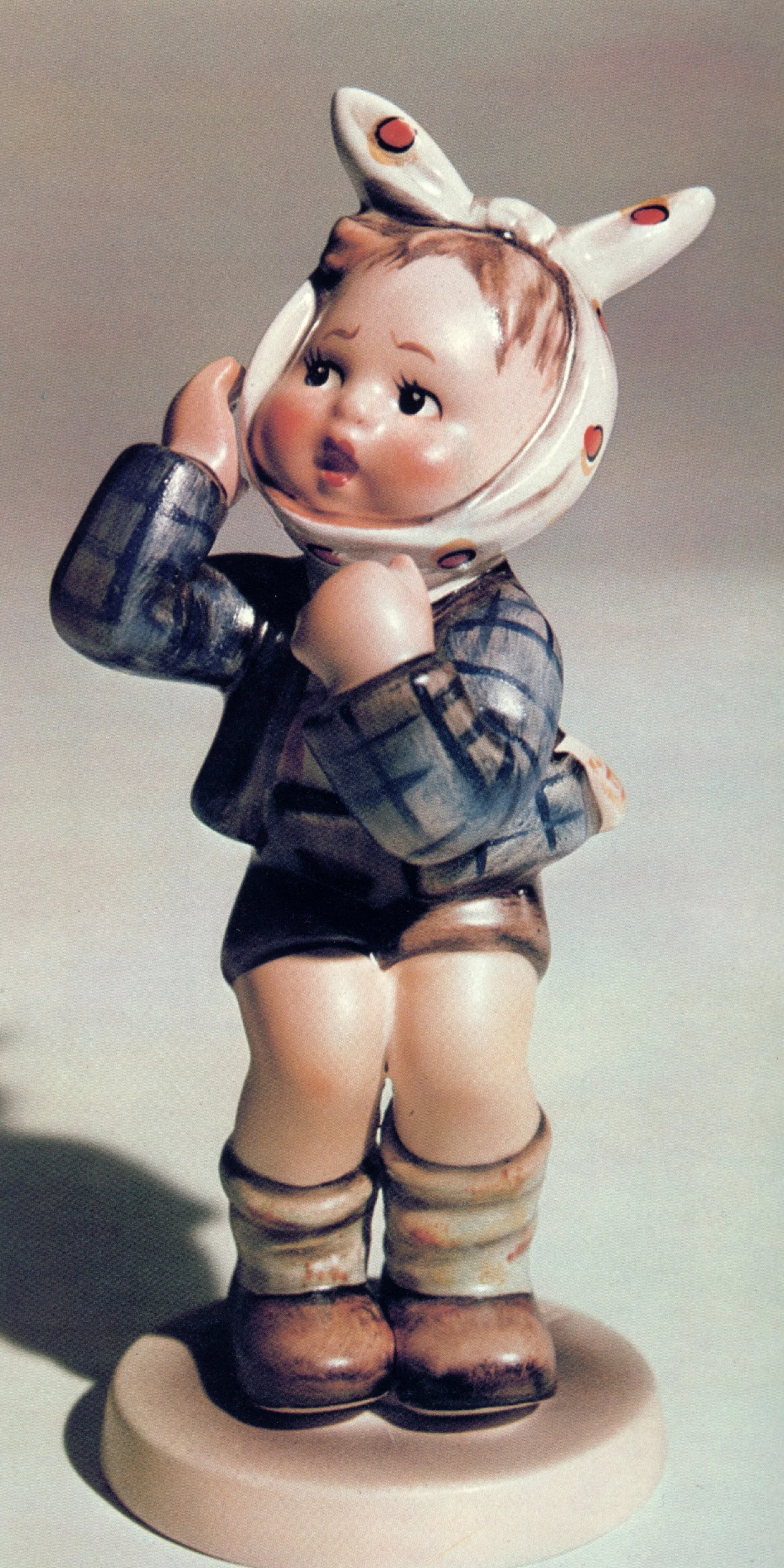
Hummel figurine. Photo from the author’s collection.
That changes the question. We no longer need to ask whether kitsch is legitimate. Of course it is. We need to ask whether its use is intelligent.
Kitsch without conviction is clutter. Kitsch without humor becomes nostalgia merchandise. Kitsch used merely to attract attention is just another algorithmic costume. But kitsch with awareness can still do something valuable: recover pleasure, memory, sentiment, exaggeration, humor, and emotional accessibility from the long shadow of respectable taste.
Good taste can be every bit as lazy as bad taste.
THE RIGHT TO EXCESS
Kitsch needs energy. It needs the force of excess—color, decoration, sweetness, theatricality, sometimes even magnificent tackiness. What makes it interesting is precisely the way it collides with established notions of taste.
But established by whom?
Design becomes sterile when taste turns into policing. The designer’s task is not to eliminate the ordinary, the sentimental, or the popular, but to understand how and why they move people—and then decide what to do with that knowledge.
That was one of the enduring lessons of Learning from Las Vegas. Look carefully before judging. Study what people actually love, use, remember, imitate, and enjoy. The “ugly and ordinary” may contain information that the beautiful and approved have learned to conceal.
So yes, my friends: kitsch is old as sin, and it is everywhere. We do not have to surrender to it, but neither should we fear it. From time to time, we should allow ourselves to enter its game—with intelligence, irony, and pleasure.
Vive l’art de vivre!
Luigi Seta, Architect
Miami, 2026
Image note: The Marshmallow Sofa image has been upgraded to the approved Herman Miller photo. For the Queen Anne Side Chair, the approved reference source is The Metropolitan Museum of Art object page; because The Met restricts direct image enlargement and download on that listing, this local web edition retains the archival chair reproduction while citing the museum record as the primary source.
SELECTED REFERENCES FOR THE 2026 REVISION
MIT Press — Learning from Las Vegas
Herman Miller — Nelson Marshmallow Sofa: Design Story
MoMA — Robert Venturi & Denise Scott Brown, Queen Anne Side Chair
Knoll — Postmodern Gold: Venturi and Scott Brown
Yale University Art Gallery — “Grandmother” Pattern
The Metropolitan Museum of Art — “Queen Anne” Side Chair
© 2026 Luigi Seta. Essay originally published in Imago, 1999. Revised edition prepared for web publication.