Casablanca in Miami Beach: When Hollywood Became Architecture
Aug 2026
Written By Luigi Seta
Design / Essay
A trip to a forgotten Miami
By Luigi Seta, Architect · Miami, 2026

01 · Vintage façade postcard. The Casablanca Hotel, Miami Beach — vintage postcard view. Publisher / Distributor: Florida Natural Color, Inc., Miami, Florida.
Some buildings reveal themselves immediately. Others make you work a little harder.
The Casablanca Hotel on Collins Avenue in Miami Beach belongs to the second group.
At first glance, there is nothing particularly mysterious about it. A long horizontal slab facing the ocean, efficient and rather restrained, exactly the sort of postwar hotel that helped populate Miami Beach with sun-seeking visitors and large automobiles.
Perfectly respectable.
But look again.
The name. The lettering. The porte-cochère. The old postcards.
Something else is going on.
And, appropriately enough, the story begins in Hollywood.
The Casablanca opened in 1949, was designed by Roy France, and, according to historical documentation from the University of Miami, was named after the celebrated film Casablanca, released only a few years earlier.
That is not a small detail.
By then, “Casablanca” no longer meant simply a city in North Africa. Hollywood had performed its usual magic and transformed geography into mythology: romance, danger, mystery, sophistication, exoticism, nostalgia, international glamour, preferably accompanied by Humphrey Bogart looking troubled in a white dinner jacket.
Quite a lot for one word to carry.
The hotel seems to have understood perfectly well what that word could bring.
Modern Architecture, with an Alibi
The main body of the Casablanca is remarkably restrained.
Roy France does not attempt to turn the entire building into spectacle. The composition is horizontal, direct, functional, very much part of the hotel architecture emerging in Miami Beach during the late 1940s and early 1950s.
The building behaves itself.
Until you reach the entrance.
There, good modernist manners begin to loosen.
The porte-cochère is not merely protection from sun and rain. Its low canopy compresses the scale, defines the threshold, and turns the arrival into a small performance. Historical postcards reveal figurative supports evoking a distinctly cinematic fantasy. So, we have an interesting arrangement.
Upstairs: modern architecture.
Downstairs: Casablanca.
The contradiction is not a problem to be solved.
It is probably the whole point.
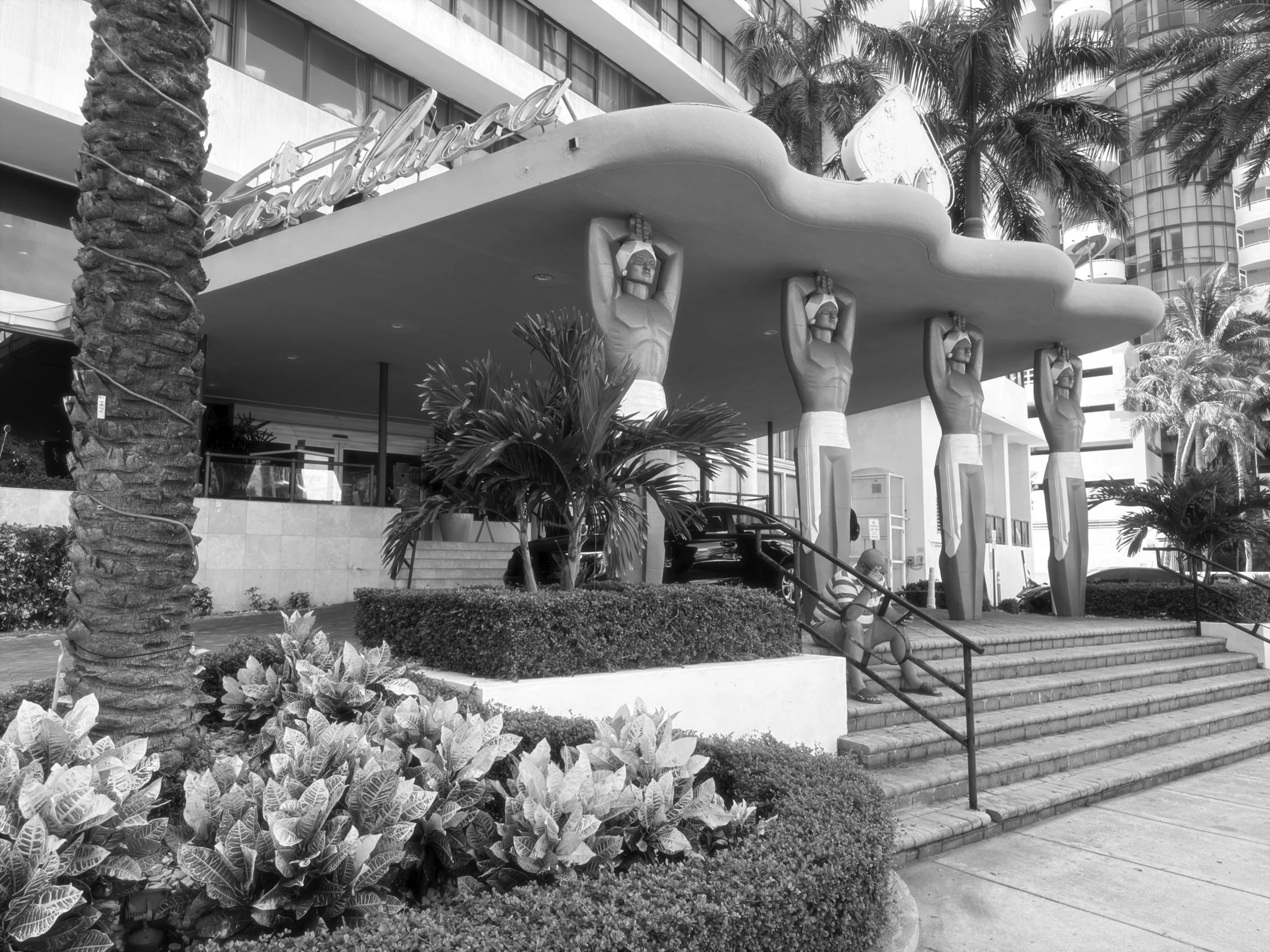
02 · Porte-cochère
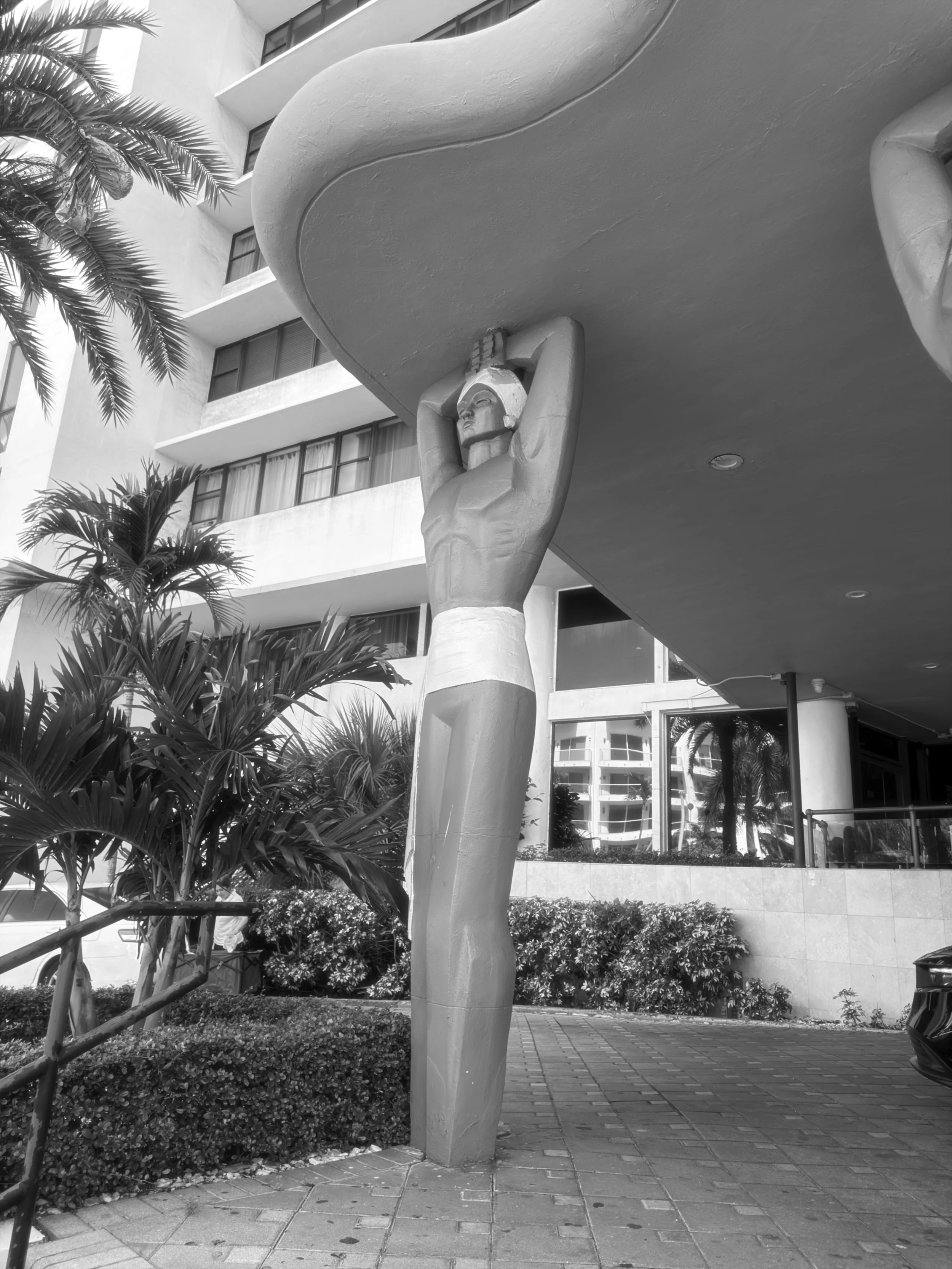
02.1 · Figurative column
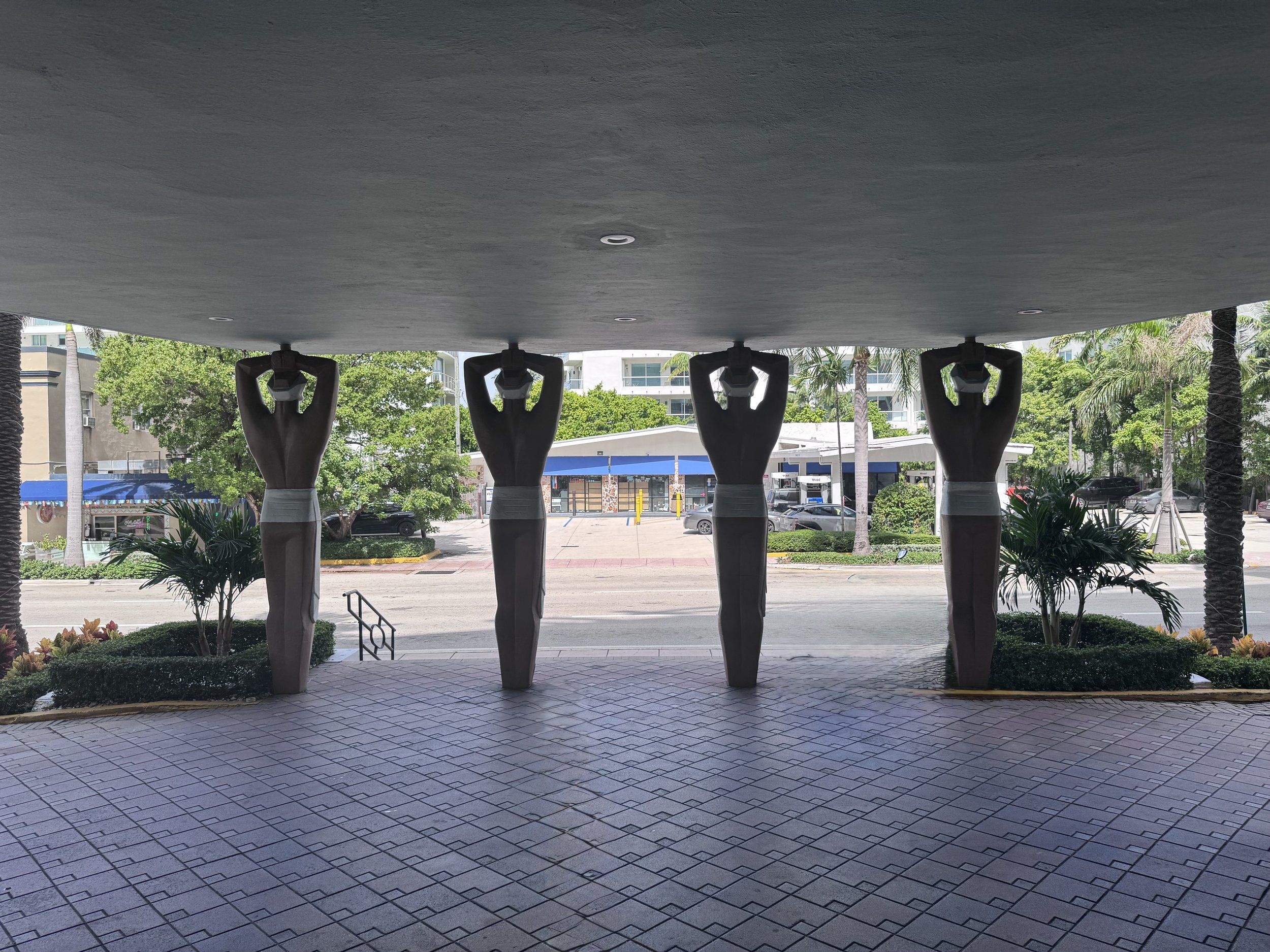
02.2 · Arrival sequence
The porte-cochère today: canopy, figurative supports, and the theatrical rhythm of arrival. Contemporary photographs: Luigi Seta.
The Porte-Cochère Does the Acting
To me, this is the most intriguing part of the building.
Modern architecture solves the hotel. The porte-cochère gives it a personality.
And personality, as architects occasionally discover to their horror, is very useful.
We do not need to establish that every decorative figure visible in every postcard was present on opening day to understand the larger strategy. Very early in the hotel's life, the entrance was clearly being treated theatrically.
It was architecture, certainly.
But it was also advertising.
The guest did not simply arrive at the Casablanca.
The guest entered Casablanca.
For a few seconds, Collins Avenue disappeared and somewhere vaguely between Morocco, Hollywood, and Miami Beach took its place.
Geographically dubious?
Absolutely.
Effective?
Very much so.
The Clue Is in the Lettering
Then there is the name itself.
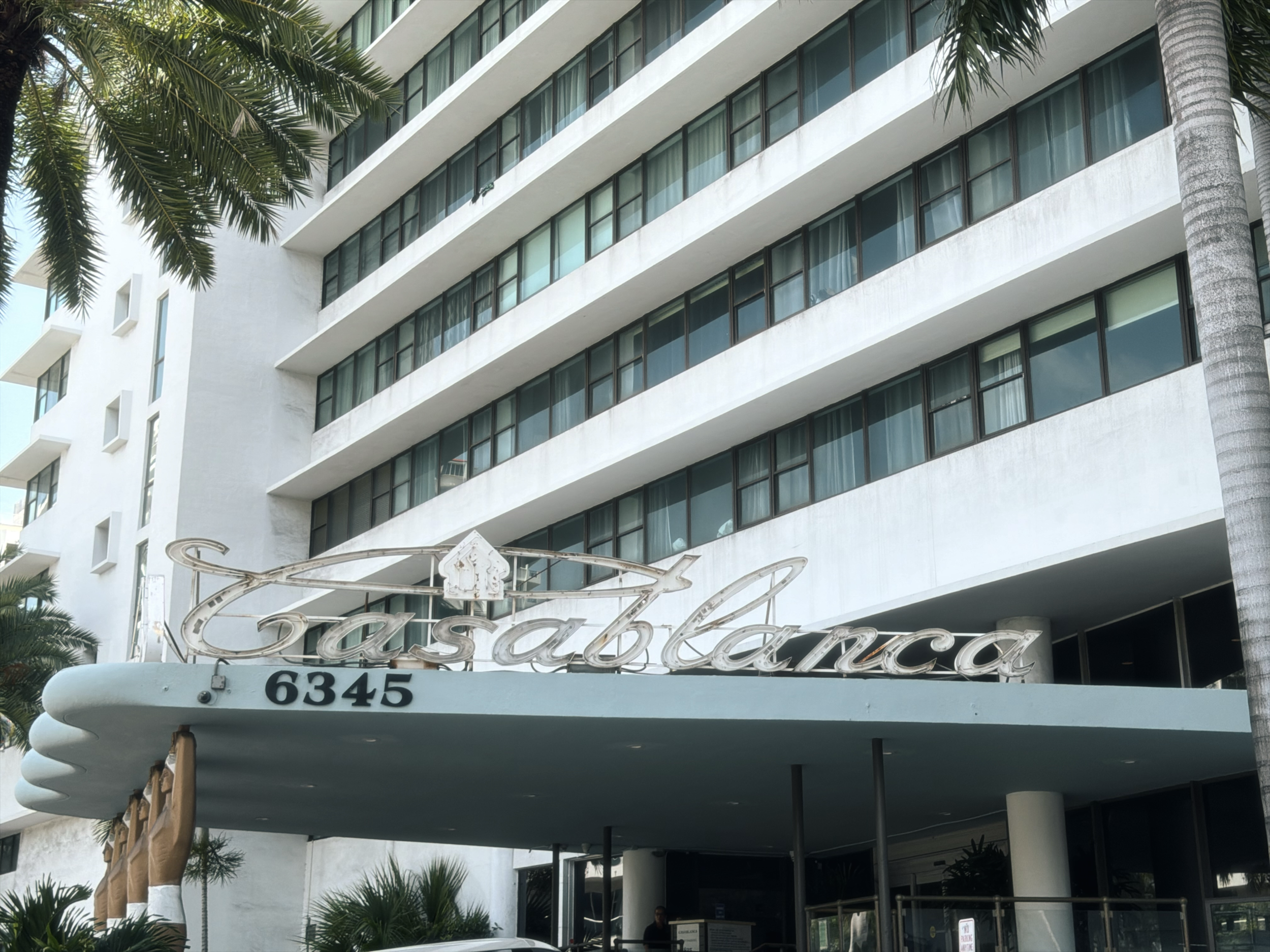
Compare the Casablanca title used in the original film posters with the hotel signage visible in early photographs and postcards. They are not identical, and I would not suggest that one was literally copied from the other.
But they are unquestionably flirting.
Both use an inclined, gestural script, elegant, theatrical, seductive, somewhere between commercial calligraphy and cinematic signage.
This is not typography attempting to disappear politely into the background.
This is typography dressed for dinner.
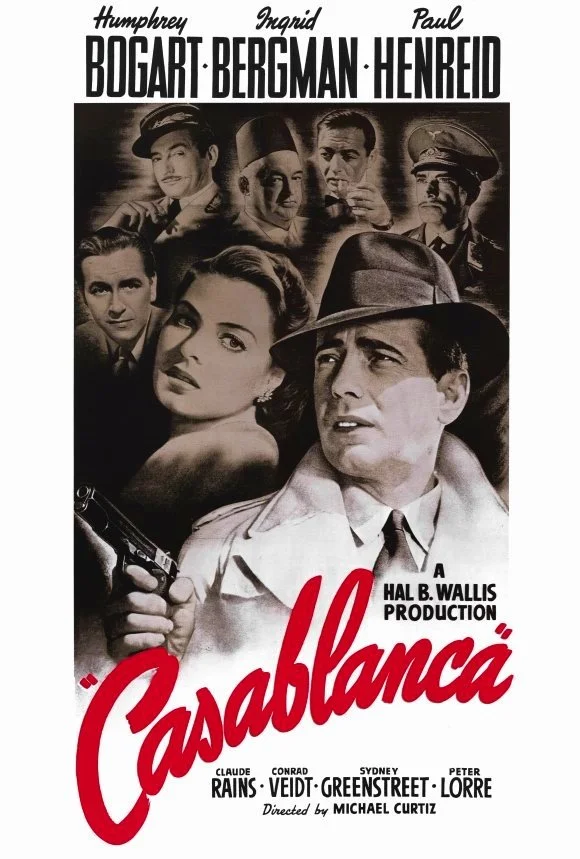
03 · Film poster lettering
03.1 · Hotel sign today
The film title and the hotel signage are not identical, but they clearly speak the same graphic language. Credit and Rights:Casablanca theatrical poster (1942), attributed to Warner Bros. and Bill Gold. This reproduction is sourced from Wikimedia Commons, whose file description identifies it as public domain in the United States because it was originally published without a copyright notice. It is reproduced here for editorial and informational purposes. Copyright status may vary by country and use; no ownership is claimed over the artwork or any associated trademarks. Source: Wikimedia Commons. Contemporary photograph: Luigi Seta.
The hotel did not need to reproduce the movie title exactly. It only needed to speak the same graphic language.
Hollywood had already done the difficult part. It had filled the word Casablanca with emotion, danger, romance, nostalgia, and several layers of imagined exoticism.
The hotel simply borrowed the luggage.
Miami Beach After the War
All of this happened at a very particular moment in American culture.
The United States emerged from World War II with tremendous confidence in the future. Automobile ownership expanded. Commercial aviation grew. Vacation travel became increasingly accessible. Consumption was not merely encouraged; it was practically patriotic.
And Florida — Miami Beach in particular — was delighted to help.
Hotels were no longer simply places in which one slept before going somewhere more interesting.
They became the interesting place.
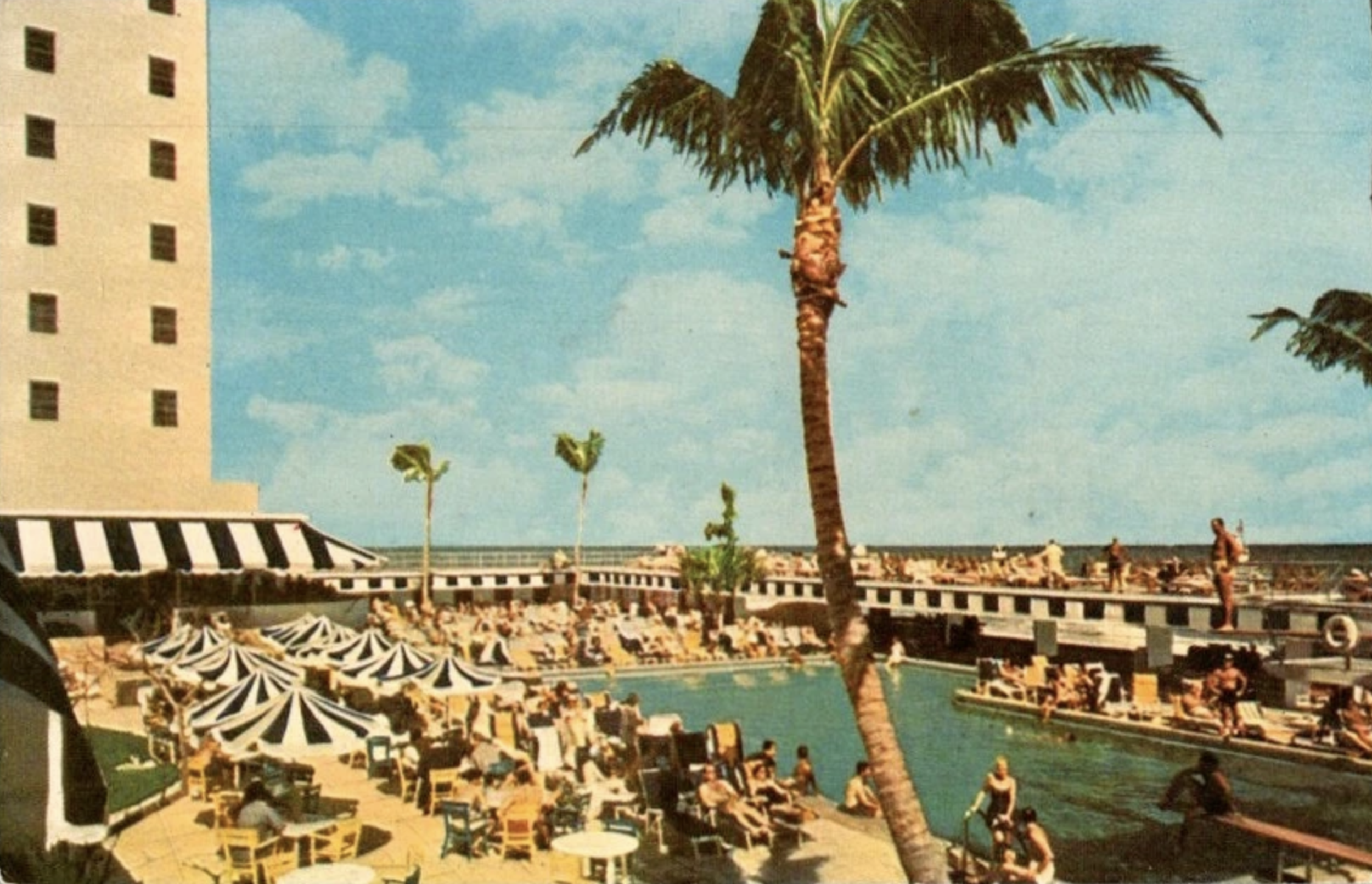
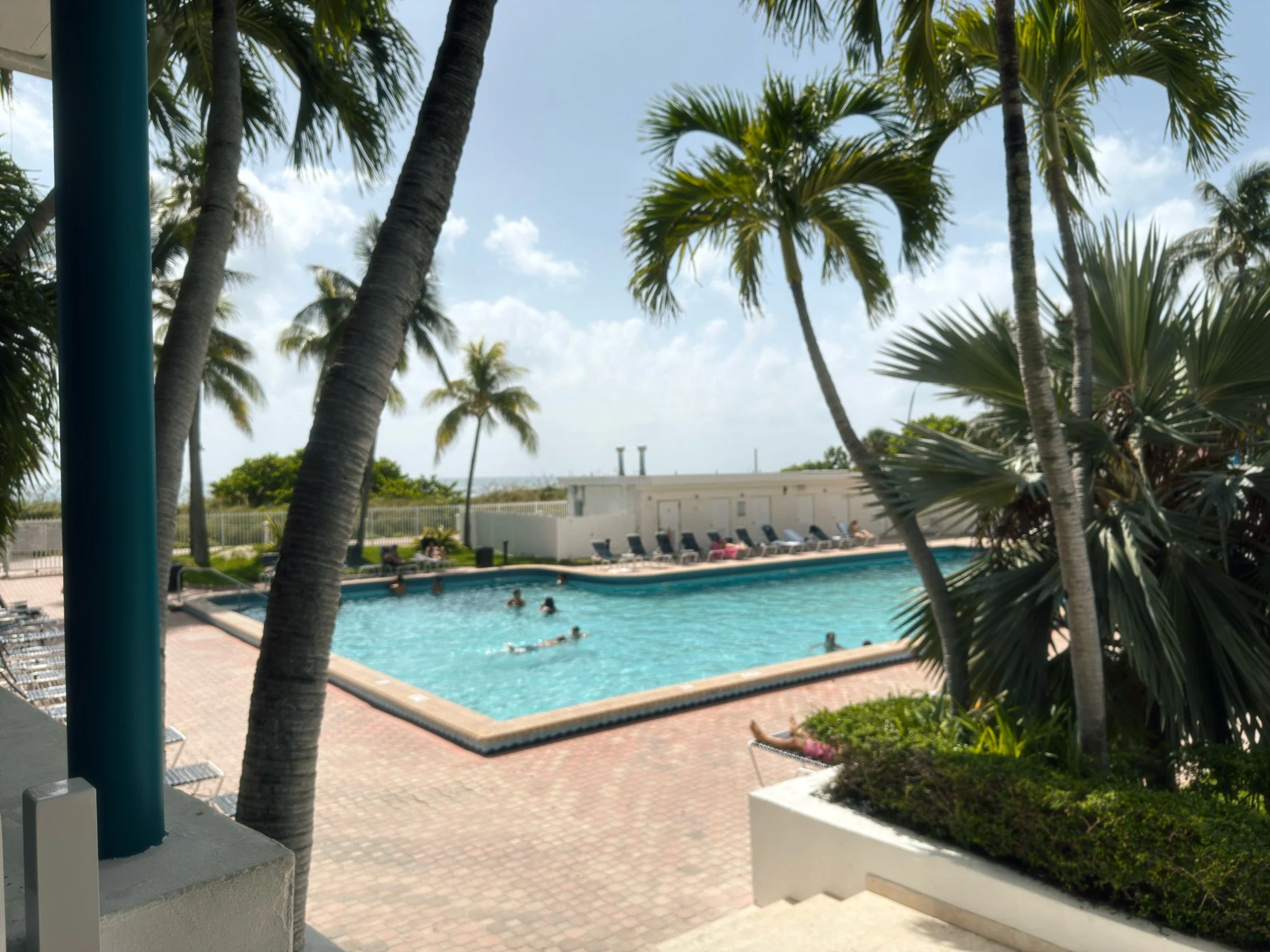
Pools, cabanas, cocktail lounges, restaurants, nightclubs, lobbies, marquees, tropical gardens, exotic names — all of it belonged to the same package.
The hotel was becoming a machine for producing experience.
Modernists might have preferred to call it program.
The guests probably called it fun.
04 · Cabanas, vintage
04.1 · Pool today
Then and now: the Casablanca's resort landscape. Vintage Casablanca Hotel postcard. Dexter Press, Inc., West Nyack, New York. Genuine Natural Color. Card No. 75030-B. Contemporary photograph: Luigi Seta.
Within that world, the Casablanca becomes especially revealing.
It did not merely offer an oceanfront room.
It offered the possibility, however briefly, of inhabiting a fiction.
And after a world war, perhaps a little fiction was exactly what everyone wanted.
Disney's Anticipated Daydream?
This brings us to a comparison that initially sounds slightly outrageous.
Which, of course, makes it worth considering.
Disneyland opened in California in 1955, several years after the Casablanca.
Now, before we credit Roy France with getting to Walt Disney a few years early, let us be clear… themed architecture had existed long before either building. World’s fairs, amusement parks, movie palaces, and international exhibitions had already demonstrated that architecture could happily abandon historical accuracy when entertainment demanded it.
Architecture has never been quite as serious as architects like to pretend.
But there is nevertheless an intriguing affinity.
The Casablanca uses a name, graphic identity, decoration, and spatial sequence to transform an ordinary arrival into a narrative experience.
Disney would later take that logic to its magnificent conclusion.
Not merely an entrance.
An entire street.
Then a landscape.
Then a kingdom.
Then several kingdoms, because apparently one was not enough.
The difference is one of intensity.
The Casablanca remains a real building onto which fantasy has been layered.
Uncle Walt would eventually make the fantasy become the building itself.
And then charge admission.

05 · Vintage animation studio. AI-generated image evoking a 1930s animation studio: an animator hand-sketching Mickey Mouse in his classic pie-eyed design on animation paper at a studio drafting desk.
Architecture Before “Branding”
Today, of course, we would call much of this branding.
We would probably organize a workshop about it.
In 1949, nobody needed the word.
The mechanism was already perfectly understood.
A movie creates a myth.
A name acquires cultural value.
Graphic design gives it a recognizable personality.
Architecture transforms that personality into space.
And the tourist buys, for a few days, the privilege of inhabiting it.
Simple.
What fascinates me about the Casablanca is not that it should suddenly be promoted into the pantheon of great modern architecture.
It does not need that burden.
Its interest lies somewhere more human.
The building is a small document of an extraordinarily optimistic moment in American culture, when architecture, cinema, tourism, advertising, and consumption began mixing together with remarkably little embarrassment.
Perhaps that lack of embarrassment is precisely what gives the period so much charm.
The Casablanca understood very early something that would later become obvious:
A successful hotel did not need to offer only rooms.
It could offer a story.
And on Collins Avenue, for a few glamorous days — or perhaps only for the few seconds beneath that wonderfully theatrical porte-cochère — the story could be called Casablanca.
Not Morocco.
Not Hollywood.
Not quite Miami Beach either.
Something much better.
A little of all three.
Play it, Sam. Play “As Time Goes By.”
Luigi Seta, Architect
Miami, 2026
Selected References
University of Miami Libraries — Travel, Tourism and Urban Growth in South Florida.
Florida Memory — The Casablanca Hotel, Miami Beach, Florida (circa 1950).
Miami Design Preservation League — North Beach Resort Historic District.
Casablanca (1942) theatrical poster — Wikimedia Commons.
Aladdin (1992) theatrical poster — Library of Congress.
Historic postcard credits: Florida Natural Color, Inc.; Dexter Press, Inc. Casablanca poster: Bill Gold / Warner Bros. Pictures / First National Pictures.
© 2026 Luigi Seta. All rights reserved.